
A dorm room gives an artificial plant two placements that are genuinely reliable: the top of the desk, and a stable shelf or a manufacturer-rated plant stand. Each has its own limit — the desk is judged by the clear working area you keep, and the shelf or stand by its rated load, how it is fixed and how much clearance sits above it. This page works through both, with the listed height, the pot-included status and the price of each piece in our potted and stem range, as shown on its product page on 14 October 2026.
Two neighbouring questions belong to their own pages: greenery in a small apartment is covered in small apartment decorating ideas with faux plants, and a desk in a home office is covered in artificial plants for office desks. This page stays on dorm-room placement.
Key takeaways
- Two dorm placements are reliable: the desk top, and a stable shelf or a manufacturer-rated plant stand. Improvised stacking — books, storage boxes, an upturned crate — is not a placement and is not used for support anywhere on this page.
- The stated sizes in this range are 7 inches or 17.8 cm from the bottom of the pot to the top leaf or longest vine for the small potted pieces, 15 inches for one potted plant and 10 leaves for one stem set. Two pieces are still waiting on a current-source check before a size can be quoted here. No product page states a base diameter or a canopy width, so measure the spot before you order.
- Five of the seven pieces are described as coming in a pot. The two stem sets ship without one, so a container is a separate cost, and no container price is quoted here because these listings do not sell one.
- Listed prices for a single piece run from $26.99 to $32.99, as shown on each page on 14 October 2026. The lowest-priced piece at $26.99 is the potted hanging bell arrangement; the potted 7-inch monstera, pothos and horseshoe leaves are $28.99 each, the potted dieffenbachia is $29.99, and the two stem sets are $27.99 and $32.99.
- For the specific pieces this page covers, none of the listings states UV resistance or a claim that the piece will hold its colour in direct sun. One listing says only that its colours are treated to reduce fading under normal indoor light, which is not a UV or long-exposure claim. That is what these listings say; it is not a statement about the whole catalogue.
- Anything fixed to a wall, shelf, bed frame or ceiling depends on your own hall's or housing office's rules. Where you can, choose a spot that needs no fixing at all.
In this guide
- Measure the two spots first
- Desk top
- Stable shelf or rated plant stand
- Prices and what is included
- Light, heat and what the pages do not state
- Dusting and small adjustments
- Fixing, hanging and your hall's rules
- Questions readers ask
- Where to go next
Measure the two spots first
Every placement question comes down to a few numbers you can take in a couple of minutes with a tape measure. Do this before you order, because no product page in this group states a base diameter or a canopy width, and those are the figures that decide whether a piece actually fits the space you have.
Desk. Measure the clear depth between the wall and the front edge, then subtract whatever your laptop, monitor stand or keyboard occupies. What is left is the footprint you can give a piece. Measure the clearance between the desktop and any hutch or shelf above it as well.
Shelf or plant stand. Measure the usable width and depth of the surface, the clearance to whatever sits above it, and — separately — the load it can carry. Rated load, anchoring and the condition of the surface are the three things that decide whether it can hold a plant at all; depth alone does not. A piece listed at 7 inches needs at least that much clearance plus enough room to lift it in and out.
If you would rather start from the measurement method than from the furniture, the artificial plant size guide works through choosing a size room by room.
Desk top
The desk is the tightest of the two placements because the surface is already doing a job. Put the piece on the side nearest the wall or in the far corner from your writing hand, so the strip in front of the laptop, monitor or keyboard stays clear. A piece that sits inside that strip will be moved every day, and it will end up on the floor.
Three of the small potted pieces are listed at 7 inches or 17.8 cm, measured from the bottom of the pot to the top leaf or longest vine rather than the pot alone: the monstera, the pothos and the horseshoe leaves, each $28.99 with the pot included. The potted dieffenbachia is $29.99 and its title states no height, so check the current product page if your desktop clearance is tight. The 7-inch pothos is described as trailing; a trail that hangs off the front edge of a desk gets caught by a chair or a leg, so keep the trail on the surface or turn the pot until it runs along the back edge.
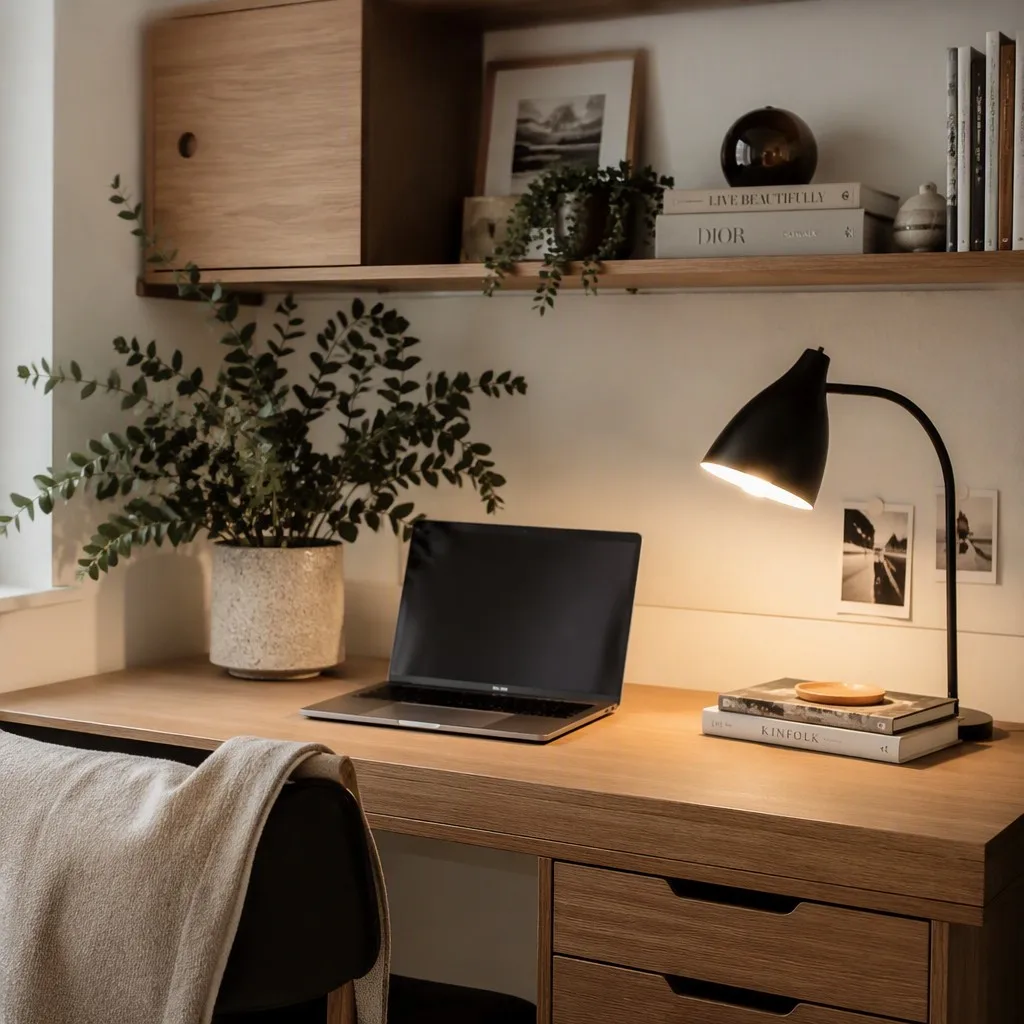
Limits to plan around: a 7-inch piece does not fit under a shelf with 7 inches of clearance, because you still need room to lift it in; the base diameter is not stated, so the footprint on the desk is unknown until you check the current page or unpack the piece; and a trailing piece on a desk is the easiest thing in the room to catch with a strap or a sleeve. The 7 inches tells you the height of the piece with its pot, not the width of its base and not how far a vine trails.
Stable shelf or rated plant stand
The safe second placement is a shelf or a plant stand that is designed to carry weight: a wall-fixed shelf checked for its fixing and its rated load, or a plant stand the manufacturer rates for the size and weight of the piece. What does not work as a placement is improvised stacking. Two textbooks, a storage box or an upturned crate is not a stand, is not rated for a load, can slide or collapse, and must not be used to raise a piece to a height or to hold a stem bundle upright.
Check the surface in this order: what the shelf or stand is rated to carry, how it is fixed to the wall or floor, what it stands on, and only then the width and depth you have to work with. A surface that is not firmly fixed, or whose load rating you cannot establish, is unsuitable. Measure the usable width and depth and the clearance above, and place the piece so its whole base sits on the surface rather than overhanging an edge.
The two smallest stated pieces suit a checked shelf directly: the horseshoe leaves at 7 inches ($28.99) and the pothos at 7 inches ($28.99), with the potted dieffenbachia ($29.99, height not stated in its title) if the shelf is deeper. Clearance is arithmetic: a 7-inch piece needs 7 inches of height plus the room to lift it in, and no page here gives you the base width, so measure the shelf depth as well.
The two stem sets are a different job, and they are the two pieces whose measurements still need a current-source check. The pink-and-green variegated plant is listed as 10 leaves at $27.99 and the peacock plant leaf bundle at $32.99; the only size figures available for them come from an earlier read, so no height is quoted for either here until a current read confirms it. Both ship without a pot, so a shelf placement has a container to add, and that container is what holds the bundle — not a stack underneath it and not loose filler on top. Check the container's opening against the bundle and its base against the shelf, and nothing should be assumed about a bundle standing on its own until you have placed it.
Two cautions worth stating plainly. Do not put a shelf or a hanging item directly above a bed, a seat or a work surface: if something comes off it, that is where a person is. And do not treat a shelf above a pillow as a plant position at all — put the piece somewhere that is not over the place you sleep.
Prices and what is included
These are the prices shown on each product page on 14 October 2026, before any tax or shipping added at checkout. A single potted piece for a desk or a shelf therefore sits between $26.99 and $29.99. The two stem sets are $27.99 and $32.99 and still need a container, which is a separate cost this page does not estimate, because none of these listings sells a container.
- Monstera in a plastic pot — listed as 7 inches / 17.8 cm from the bottom of the pot to the top leaf
- $28.99. Pot included. No base diameter or canopy width stated. Reusable per the listing.
- Pothos in a plastic pot — listed as 7 inches / 17.8 cm from the bottom of the pot to the longest vine, described as trailing
- $28.99. Pot included. No base diameter or canopy width stated, and no trailing length. Reusable per the listing.
- Horseshoe leaves in a white plastic pot — listed as 7 inches / 17.8 cm from the bottom of the pot to the top leaf
- $28.99. Pot included. No base diameter or canopy width stated. Reusable per the listing.
- Dieffenbachia in a plastic pot — no height stated in its title
- $29.99. Pot included.
- Pink-and-green variegated plant — listed as 10 leaves
- $27.99. Pot not included. The product page names one plant in its title and another in its address, so it is listed here by its colouring and leaf count rather than by a species. No current-source size figure, so none is quoted.
- Peacock plant leaf bundle — size awaiting a current-source check
- $32.99. Pot not included. The earlier read's figure is not re-verified in the current source, so no height or stem count is stated here.
- Dark green hanging bell arrangement in a cylindrical plastic pot
- $26.99. Pot included. Listed height 4.2 inches / 10.7 cm. The listing gives no total drop and no hardware load rating, so treat both as unknown rather than assuming a hanging reach.
What the pages do not give you: a base diameter for any piece, a canopy width for any piece, and a height for the potted dieffenbachia, whose title states none. Four of the seven state a height: the hanging bell at 4.2 inches, and the three 7-inch pieces measured from the bottom of the pot to the top leaf or longest vine. The 7-inch figure is the listing's own description of the piece with its pot, not a base measurement and not a trailing length. Check the current product page before ordering, and re-measure your spot against whatever that page says now.
Light, heat and what the pages do not state
An artificial piece needs no growing light, which is exactly why a dim dorm room, a corner away from the window, or even a windowless room is a legitimate place for one. That is the only light-related claim this page makes.
For the pieces on this page, none of the listings states UV resistance or long-exposure fade resistance. So do not choose a sunlit window position on the strength of a UV label, because none of these listings carries one, and none describes the piece as colour-stable in direct sun. One listing — the pothos — says only that its colours are treated to reduce fading under normal indoor lighting, which is not a UV or all-day-sun claim. This is a statement about the listings read for this page, not about every product in the catalogue.
What you can control is the spot itself. Keep a piece out of all-day direct sun through glass and away from a radiator or a heat vent, because sustained light and heat affect how a finish ages over time. That is a placement caution rather than a promise about any particular piece.
Dusting and small adjustments
Dust is the one thing you will certainly have to deal with, and the safe baseline is dry: a soft cloth or a soft brush, working from the stem towards the tip, and go by what you can see rather than by a fixed monthly schedule. What each listing then permits differs by piece, so read the care note for the one you own. The potted monstera and pothos listings allow a dry or slightly damp cloth, or a duster; the horseshoe leaves listing allows a damp cloth or cool hairdryer air; the calathea stem listing says a damp cloth. The other pieces state no cleaning method in the details read for this page, so dust those dry and check their own care note. None of these listings documents washing, rinsing, sprays or alcohol, so keep to a wipe or a dusting and do not soak a leaf.
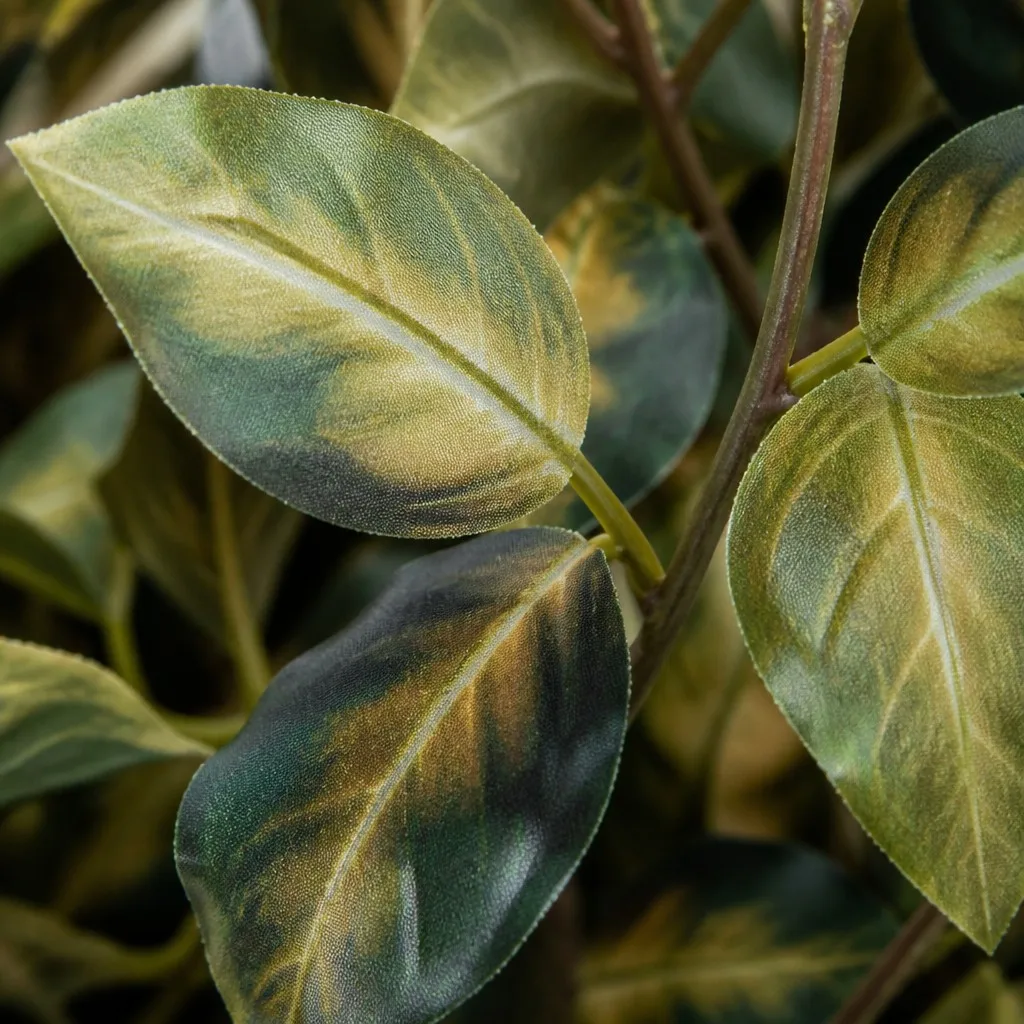
Close range is where the difference between pieces shows, and it is also where you notice a leaf that has been pushed out of shape. Where a product page describes the foliage or the stems as adjustable, adjust within what it describes; the potted monstera and pothos listings are the two here that document a wire you can shape. Where nothing is documented, leave the piece as it arrives and change the look with placement instead, rather than forcing a stem you cannot judge.
If a piece has small detachable parts, or you have added moss, stones or another loose filler, keep them out of reach of children and pets that pick things up, check for loose parts after the piece has been moved, and treat a high shelf as a placement for the piece rather than as a guarantee that a child or a pet cannot reach it. Nothing on this page is a claim that a piece or a filler is non-toxic, edible or safe to swallow.
Fixing, hanging and your hall's rules
There is no single answer to what you may attach to a dorm wall, shelf, bed frame or ceiling. Rules are set by individual halls and housing offices and they differ from building to building, so a method that is fine in one room may be prohibited in the next. Ask your own hall or housing office before you fix anything, and before you use any adhesive, hook or removable strip.
The simplest way to avoid the question is to choose a placement that needs no fixing at all: a desktop, a shelf the room already has, or a manufacturer-rated plant stand on the floor.
If hanging is the only option and your hall permits it, match the method to what the product's own page documents. The dark green hanging bell arrangement is described as a hanging arrangement, but its page states no hook, bracket or cord and gives no hardware load rating, so do not assume mounting parts are included or that the pot can hang at all. For damage-free hanging methods that can be adapted to a dorm room, see no-drill ways to hang plants in a rental, and confirm the method with your hall before you put anything up.
Questions readers ask
Does an artificial plant need a window in a dorm room?
No. Nothing in this range needs light to keep its appearance, so a window is a styling choice rather than a requirement. What a window position does bring is direct sun and heat, which is what the light section above is about.
Can I put a plant on the bed frame or a rail beside the bed?
That is not a placement this page recommends. A bed frame or a rail is not a surface, it moves when someone gets in and out, and the space beside the bed is the sleeping and foot traffic line. Use furniture beside the bed that is made to stand on its own floor space — a small bedside table or a rated stand placed outside the line you walk when you get up — and keep shelves and hanging items off the space above anywhere you sleep or sit.
Can I stack books or a box to raise a plant?
No. A stack is not rated for the load, it can slide, and it is not a substitute for a shelf, a table or a manufacturer-rated plant stand. If the height you want is not available from a real surface, choose a taller piece or a different spot.
How do I clean dust off without damaging the finish?
Start dry, with a soft cloth or a soft brush from stem to tip, then follow the care note for the specific piece: the potted monstera and pothos allow a dry or slightly damp cloth or a duster, the horseshoe leaves allow a damp cloth or cool hairdryer air, and the calathea stem says a damp cloth. None of the listings on this page documents washing, rinsing, sprays or alcohol.
Where to go next
Start with the spot you use most. In most dorm rooms that is the desk, and it is also the easiest to get wrong, because a piece there has to earn its space inside the clear area you work in. Measure that spot before you buy, and let the measurement rather than the product photograph decide the size: the two figures these listings do not give you are the base diameter and the canopy width, and those are exactly the ones your own tape measure supplies. If a piece turns out to be larger than the surface you measured, no arrangement will shrink it — that is a size decision, and it is worth making before checkout.