
To make artificial greenery work in a home office, place it against the three zones the room actually has: the floor beside the desk, the top of a cabinet or shelf, and whatever your camera sees on a video call. Each zone has its own measurements and its own constraints, and a piece that suits one will not suit another. Work through the measurements below, choose the silhouette that fits the zone, and skip anything that would sit in the chair's path, on the work surface, or in the door's swing.
Key takeaways
- Measure the zone before the plant. Desk-side clearance, cabinet-top width and depth, the camera's actual frame, the door swing and the cable run all decide what fits.
- A floor piece needs clearance, not just a corner. Leave room for the chair to roll back and for anyone to walk past, and keep the pot out of the door's arc.
- Cabinet and shelf tops fill the wall without touching the work surface. Check the surface's width and depth, and remember the finished height is the surface height plus the piece.
- For a video call, check the frame, not the wall. Open your camera preview and see what the shot actually includes before you buy anything.
- Equipment changes the conditions. The area around a computer, monitor or printer can run warmer and drier than the rest of the room and collects dust; keep the piece out of the hottest spot, leave the equipment's vents clear, and follow the care note on the listing you buy.
In this guide
- The three zones, and what each one needs
- Zone 1: a floor piece beside the desk
- Zone 2: a cabinet or shelf top
- Zone 3: the video-call background
- Five silhouettes, and the zone each one suits
- Assembly, shaping, dust and heat
- Common questions
The three zones, and what each one needs
A home office is usually a room with equipment in it, which changes what greenery has to live with. The area around a computer, a monitor or a printer can run warmer and drier than the rest of the room, vents and cable runs need to stay clear, and the floor space is shared with a chair that moves. Before choosing a piece, take five measurements:
- Floor clearance beside the desk. The width between the desk edge and the nearest wall or furniture, and how far the chair travels when it rolls back.
- Cabinet or shelf top. The usable width and depth of the surface, and how much of the wall above it you want covered.
- Camera frame. What your webcam actually captures when you sit in your normal position.
- Door swing and walkway. The arc of any door or cupboard, and the path someone uses to get to the desk.
- Heat and cabling. Where the warmest spot is, and which run of cable or vent must stay clear.
Those five numbers, taken together with the finished height of the piece, decide more than the species does. The artificial plant size guide sets out how to convert a listed height into a finished arrangement height, which matters most when a piece goes on top of something.
Zone 1: a floor piece beside the desk
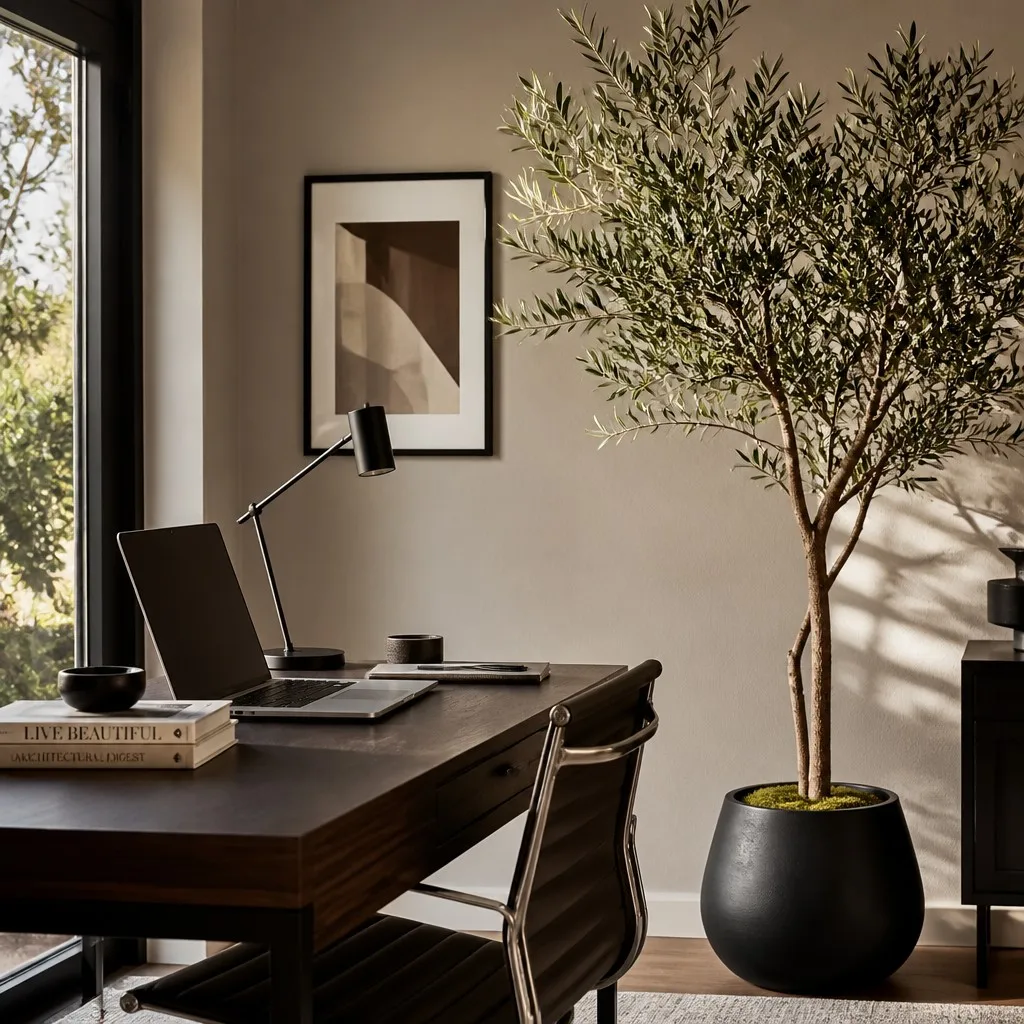
The floor generally suits a taller piece, because that is where a full-height form can stand without occupying a surface — but it is not the only workable position, and a piece on a cabinet or a shelf top has its own constraints. Whatever position you choose, check what carries it, how much height is available and how much room is left for the chair and for anyone walking past. Put a floor piece beside the desk rather than behind it — the corner behind a desk is usually where the cable run and the power strip live — and check three things before you commit:
- Chair clearance. Roll the chair back as far as you normally would and confirm you still have room. A pot standing in the chair's path can be caught when the chair rolls back.
- Door and walkway. Nothing should stand in the swing of a door or in the route to the desk, whatever the corner looks like from the doorway.
- Heat sources. Keep a piece away from a radiator, a vent, or the exhaust vents of a computer, monitor or other equipment, and follow the equipment maker's own clearance requirement rather than assuming a fixed distance; warm, dry air affects how a finish ages.
A tall, upright silhouette suits this zone because it fills vertical space without spreading into the chair's path. Stand back and look at the gap between the top of the piece and the ceiling: if the piece is much shorter than the wall, it can make the room feel unresolved, so compare the piece's actual height with the height of the space rather than buying on the nominal size alone.
Zone 2: a cabinet or shelf top
Raising greenery onto a cabinet, a bookshelf or a filing cabinet gets it off the floor and out of the chair's way, and it fills the wall at eye level. It also adds two requirements that a floor piece does not have:
- The surface has to carry it. Check the usable width and depth of the top and whether the piece will overhang. A piece whose foliage spreads wider than the surface looks unstable and gets knocked in passing.
- The finished height is a sum. Floor-to-tip height = the height of the support surface + the measured finished arrangement height. A piece that ships in its own container already includes that container in its overall height, so do not add the pot again or subtract an assumed stem insertion; a piece that ships as bare stems needs the container added, and the finished height is the container, plus the visible stem length once it is set in place. Measure the arrangement where it stands rather than trusting a listed figure.
Keep the top clear of the cable run and any vent, and leave a little space around the piece so it does not crowd the wall or the objects next to it. A mid-size piece with an upright habit suits this zone better than a wide, spreading one, because it grows upward instead of sideways into the room.
Zone 3: the video-call background
The background of a video call is a frame, not a wall, and it is the one zone where you can test the result before you buy. Open your camera preview, sit where you normally sit, and look at the shot:
- What is already in the frame. Note the door, the shelf, the lamp and any clutter the camera picks up, and decide what the greenery should cover or soften.
- Where the piece would sit in the shot. A piece at roughly head-and-shoulder height reads as part of the room; one much lower disappears behind you, and one much taller dominates the frame.
- What it would block. Nothing in the shot should hide the door or a light switch, and nothing should be cropped in a way that looks accidental.
An upright, sparse silhouette usually works better here than a dense one, because the camera renders it as texture rather than as a solid block of green. If the frame is tight, a smaller piece on a cabinet at the edge of the shot does more than a large piece behind the chair. Desk-level pieces are a separate decision with their own constraints — footprint on the work surface, keyboard clearance and cord routing — and the options for that spot are covered in the guide to artificial plants for office desks rather than here.
Five silhouettes, and the zone each one suits
These are five different shapes rather than a ranking, and each one answers a different placement problem:
- A narrow, airy tree with small leaves, such as an artificial olive. It reads as light rather than dense, so it suits a smaller office where a broad canopy would dominate, and it works beside the desk or as a corner anchor.
- A large, broad-leaf tree, such as a faux fiddle leaf fig. It adds weight and a strong vertical line, which suits the wall behind or beside the desk; give it more clearance, because the canopy is wide.
- Muted, grey-green sprays or a bush in the eucalyptus family. The pale, matte colour recedes rather than dominates, so it suits a shelf or cabinet top and a background that has to stay quiet on camera.
- A structural, paddle-leaf piece, such as a bird of paradise. Big shapes give a plain room a focal point, so it suits a corner or a wall the camera sees; check the spread against the chair's path.
- A slender, upright form with narrow leaves, such as a dracaena silhouette. It adds height in a tight footprint, which makes it the natural choice where the gap beside the desk is narrow.
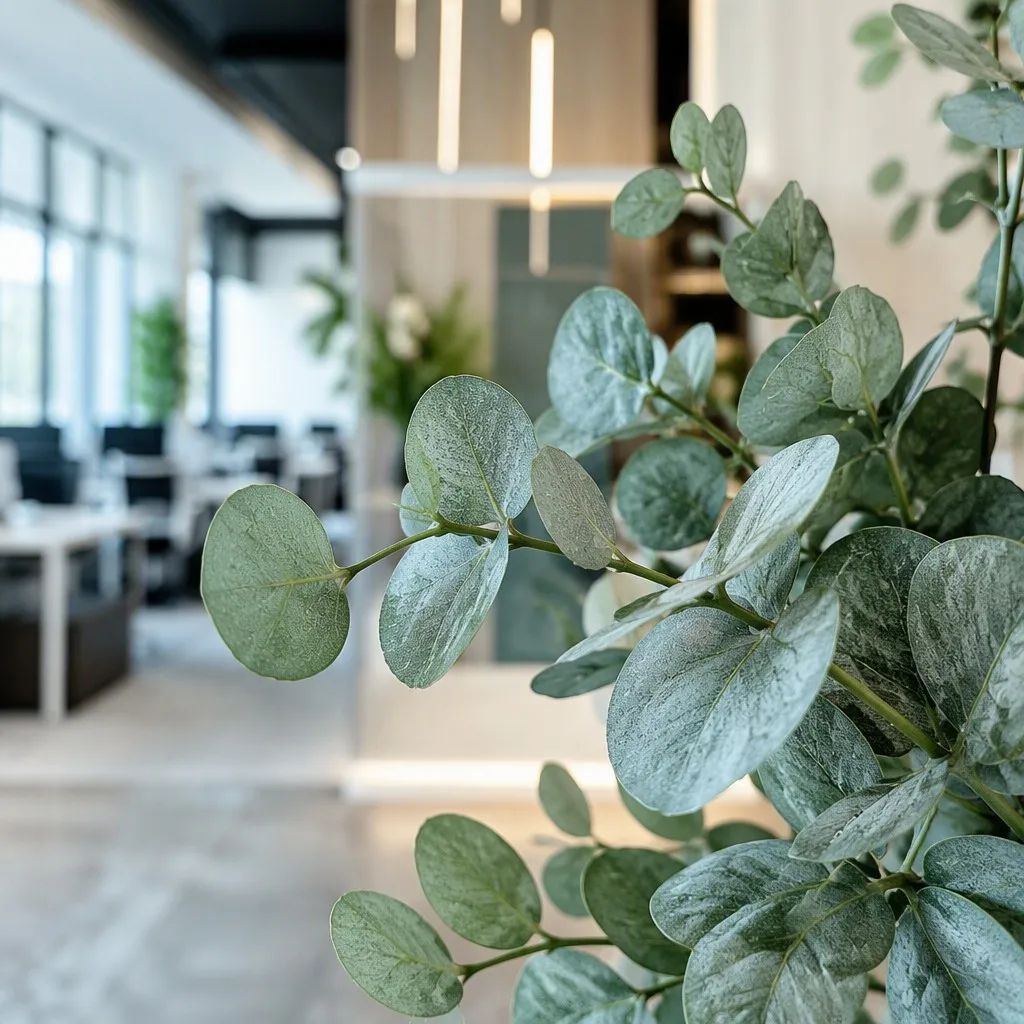
Which of the five fits is decided by the measurements above, not by the name. Two pieces with the same label can differ in height, spread and pot size between listings, so check the specific listing for the piece you are buying and treat the silhouette as the guide.
Assembly, shaping, dust and heat
Three practical points belong with any piece in a home office:
- Assembly varies by listing. Some pieces arrive in one piece and some arrive in sections with a base to fit. Check the listing rather than assuming, and plan where you will set it up — a tall piece is easier to assemble on the floor than in a corner behind a desk.
- Shaping follows the maker's note. Where the listing documents adjustable stems, you can spread and lift the foliage within what it describes; where it does not, place the piece as it arrives. Do not force a stem or a leaf you cannot judge.
- Dust is the maintenance. A desk area collects dust, so dust the piece with a dry microfibre cloth or a soft brush, working from the stem to the tip, and check the care note on the specific listing before using anything damp. Keep the piece out of the warmest, most direct position, because heat and dry air are harder on a finish than a shaded corner.
Common questions
Will greenery make me more productive or less stressed?
This page does not make that claim. What changes when you add a piece is the look of the room: it fills a bare corner, softens hard lines and gives the camera something to frame. Treat it as a styling decision and judge it on how the room reads.
How do I choose the right size tree for my office?
Measure the zone first — floor clearance and chair travel for a floor piece, surface width and depth for a cabinet top, and the camera frame for a background piece — then compare those numbers with the arrangement's finished height, measured where it stands: a piece that ships in its own container already includes it, and a bare-stem piece needs its container added. The artificial plant size guide covers the measurement method in full.
Do artificial trees require assembly?
It varies by listing, so check the product page: some arrive ready to stand and some need the base fitted and the foliage opened out. Where the listing says the stems are adjustable, shape them within what it describes; where it does not, leave the piece as it came.
Can a piece sit on my desk?
Yes, with conditions: it must not eat into the keyboard and mouse area, it must not block a vent or a cable run, and it should be stable enough not to move when you reach past it. Desk-sized picks and their footprint constraints are handled in the office desk guide.
How do I keep it looking tidy in a working room?
Dust it regularly with a dry cloth or soft brush, keep it out of the warmest spot, and re-check the shape after it has been bumped — a piece beside a moving chair can be caught by it. Check the care note on the listing for anything beyond dry dusting.
Finishing thoughts
Measure the three zones, choose the silhouette that fits the one you are filling, and keep the piece out of the chair's path, the door's swing and the work surface. Done that way, the greenery stops being a decorating gamble in a working room and becomes part of how the space is set up. For a shortlist of desk-sized pieces, the office desk guide is the place to start.