
Biophilic design on a budget is not about buying fewer plants — it is about deciding which two or three surfaces in a room deserve greenery, as the wider guide to biophilic interior design sets out. For most homes, a workable starting point is one larger plant that anchors the main sightline, one or two smaller pieces for a shelf or console, and containers you source separately. At Botanical Villa's current prices, the plants in that setup run about $30 for a single anchored corner, $57 for a two-piece layer, or roughly $91 for a three-piece base. The containers are a separate line item you control.
This guide covers what a low-budget biophilic room actually costs, three plans with the assumptions written out, why plant and container budgets should never be merged, and which cheap shortcuts give a faux plant away.
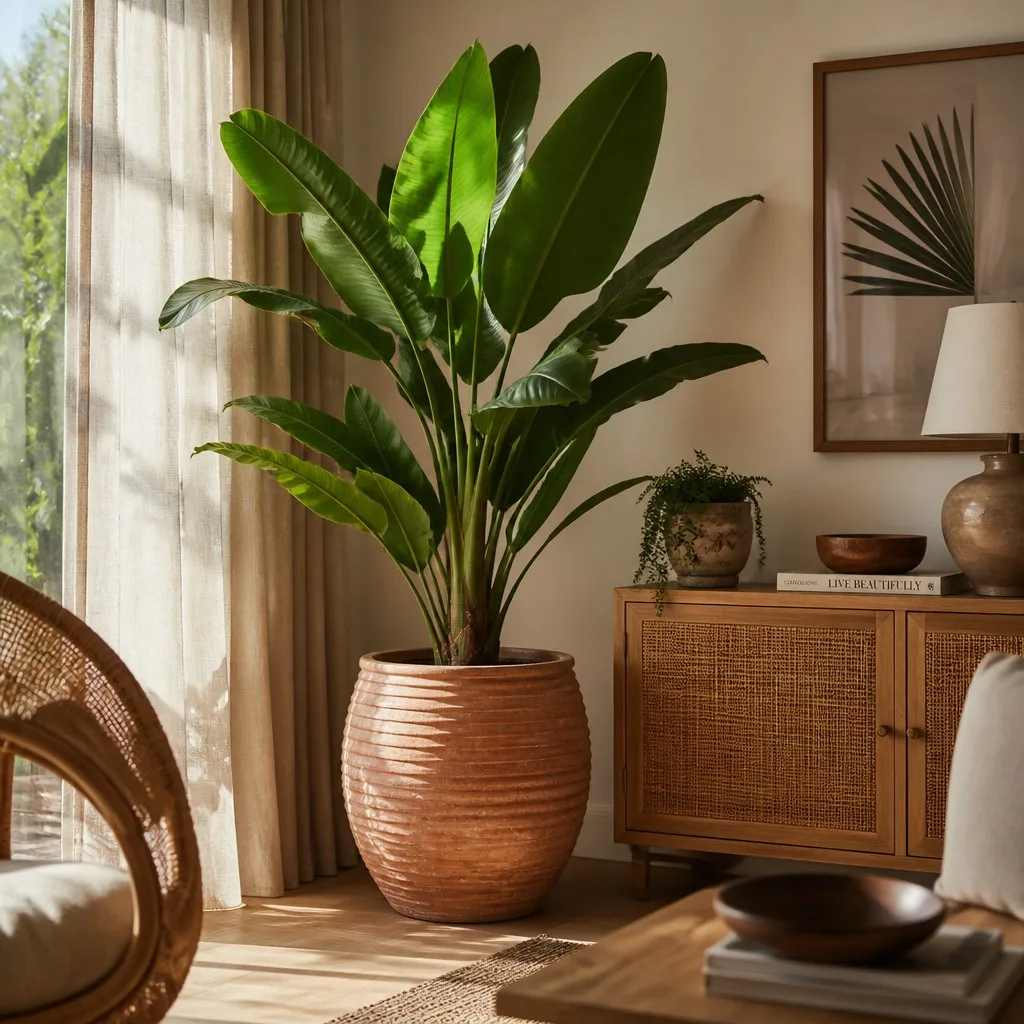
Styling illustration.
Key takeaways
- Budget biophilic design works through placement and proportion, not through the number of pieces you buy.
- Price plants and containers separately. The three pieces used in these plans ship unpotted, so the container is a separate purchase — from what you already own or from a local shop.
- Unpotted plants need a container with the right opening and enough weight to stay upright. The 32" Artificial Banana Plant is specified for a 7–9 in (18–23 cm) opening and ships with no pot, no soil and no moss.
- The three plans below use prices read from the store on 2026-10-10 and state every assumption, so you can change one assumption without redoing the maths.
In this guide
- What a budget biophilic room actually costs
- Three low-budget plans and the assumptions behind them
- Why plants and containers are two different budgets
- Choosing a container that carries a cheaper plant
- Where budget faux greenery goes wrong
- FAQ
What a budget biophilic room actually costs
"Biophilic" describes a room that keeps natural shapes, textures and colours in view. It does not require real plants, and it does not require a plant in every corner. Two or three deliberate pieces usually read as more natural than six scattered ones, and they are cheaper to assemble.
Prices in the table are plant-only prices and were current on 2026-10-10. They move, and a planter is never part of them — check the product page before you order.
Piece
- 32" Artificial Banana Plant, 18 leaves (unpotted)
-
Plant price (2026-10-10): $29.99
What it is for: One anchored corner or console; 2.7 ft tall with a 27.5 in canopy
- 12-Leaf Artificial Traveler's Palm (pot not included)
-
Plant price (2026-10-10): $26.99
What it is for: A second height on the opposite side of the room
- About 30" Artificial Peacock Plant Stems, 9 leaves
-
Plant price (2026-10-10): $32.99
What it is for: Vase or tall-basket filler for a surface
- 10-Leaf Artificial Dieffenbachia, 14"
-
Plant price (2026-10-10): $27.99
What it is for: Small fill for a shelf, desk or narrow gap
Container cost is deliberately absent from the table. Every piece in these three plans ships unpotted, so a planter is a separate purchase for this plan — buy it used, use one you already own, or pick up a matte pot locally. Buying a container you like is also the cheapest way to lift a mid-priced plant, which is why it gets its own line in the budget rather than being treated as free.
Three low-budget plans and the assumptions behind them
Each plan states what it assumes about your room. If an assumption does not hold, move to the next plan instead of adding pieces.
Plan 1 — One anchored corner: $29.99 in plants
- Assumes: one genuinely empty corner or a bare wall you look at every day, and one container you already own or can source locally.
- Buy: one 32" Artificial Banana Plant, 18 leaves (unpotted) — $29.99.
- Why it works: a single taller piece with a wide canopy can anchor the corner, provided its installed height and spread match the space you measured; its 18 wired leaves can be fanned open for an airy silhouette or closed for a denser block of green.
- Do not add: a second full-size plant in the same room. Two large pieces in a small space compete and make both look cheaper.
Plan 2 — Two heights, one sightline: $56.98 in plants
- Assumes: one wall or sightline where you want green at two heights — a floor piece plus a surface piece — and two containers.
- Buy: the 32" banana ($29.99) plus the 12-Leaf Traveler's Palm ($26.99) = $56.98.
- Placement: the taller, wider piece sits at the end of the sightline; the second piece sits higher and smaller, on a console or shelf, not directly beside the first.
- Do not add: matching pots on both. Repeating the same container on two pieces flattens the room; vary height and material instead.
Plan 3 — Three-piece base for a whole room: $90.97 in plants
- Assumes: a living room or open-plan space you want to read as finished from the sofa, plus three containers.
- Buy: the 32" banana ($29.99), About 30" Peacock Plant Stems, 9 leaves ($32.99), and the 10-Leaf 14" Dieffenbachia ($27.99) = $90.97.
- Structure: one floor piece for scale, one vase or basket of stems for height on a surface, one small dense piece to fill a gap the eye lands on.
- Upgrade path, not a starting point: the 24-Leaf Luxury Faux Banana Tree was priced at $35.99 in the 2026-10-09 product snapshot. Buying it on top of Plan 3 pushes plants past $120, so treat it as a replacement for the 32" banana only if you need a wider anchor.
Why plants and containers are two different budgets
The most common budget mistake is judging a plant by its price tag while ignoring what has to hold it. An unpotted plant is an unfinished object: until it sits in something with the right opening and enough weight, it will lean, tip or look like packaging.
- Plant budget: the foliage itself. In these plans the individual pieces run from $26.99 to $32.99.
- Container budget: what you put it in. Set this first if the plant is going on a walkway or next to a door, because stability matters more there than style.
- Finish budget: moss, stones or sand at the base. If you need extra stability, stones or sand do double duty — but they are an extra line, not a free upgrade.
Keep the two lines on paper before you buy. If the container budget is tight, buy the smaller plant rather than an oversized one that overhangs its pot; proportion is what makes a cheap arrangement look intentional.
Choosing a container that carries a cheaper plant
Two measurements decide whether a container works before style comes into it.
- Opening size. The 32" banana needs an opening of roughly 7–9 in (18–23 cm). The planter shown in its product photos is not included, so measure your pot before you buy the plant.
- Weight and footprint. Wired foliage is light — the 32" banana weighs about 0.45 lb (202 g) — so a light, narrow container is the reason a plant tips. A heavier container, or stones/sand at the base, fixes it. If you have children, pets or a walkway beside the plant, that is where to spend the container money.
On finish: a woven basket, a matte terracotta pot or a tall cylinder all suit the pieces above. Setting the 32" banana in a taller 15–20 in planter is also the quickest way to raise the arrangement toward eye level without buying a taller plant. Once the container is settled, the five-step faux plant styling process covers placement and shaping.
Where budget faux greenery goes wrong
Four failures account for most "cheap-looking" artificial plants, and each has a low-cost fix.
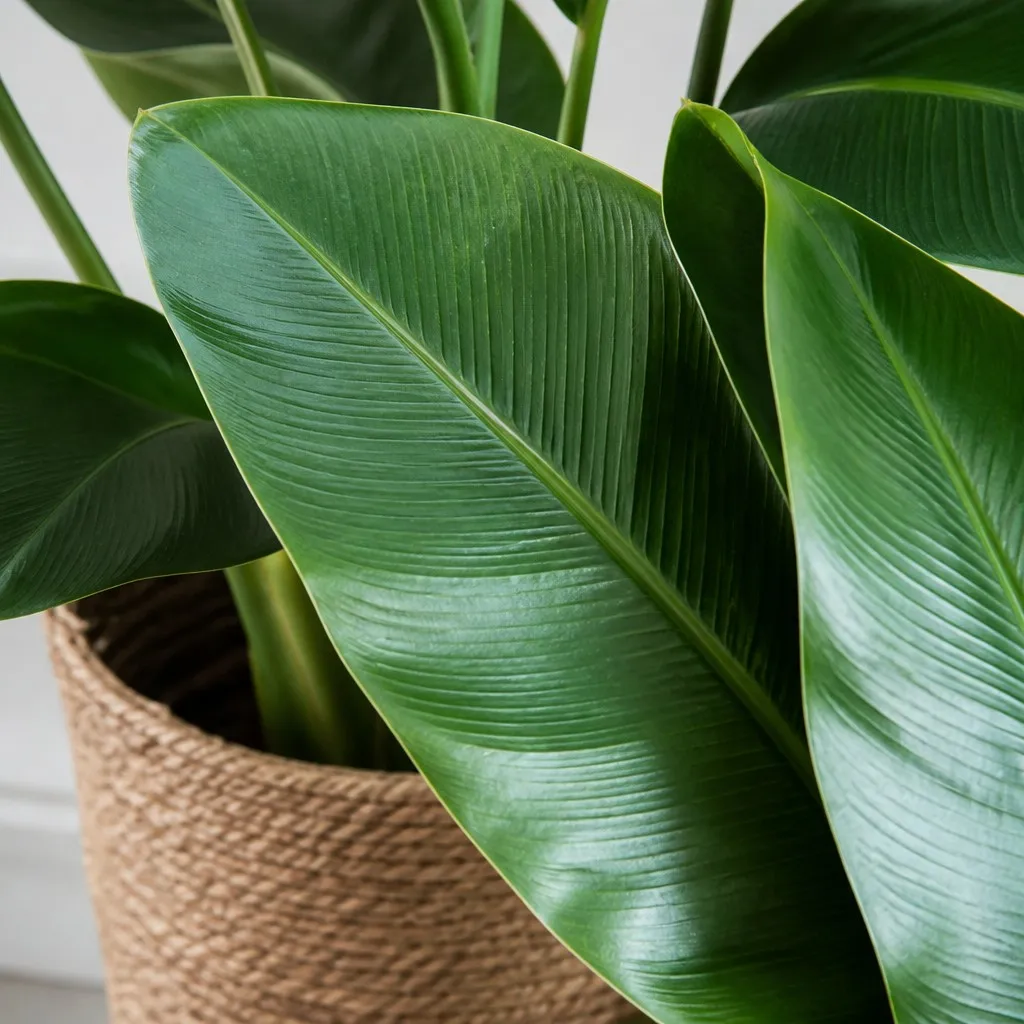
- Shine. Glossy leaves read as plastic under indoor light. Look for a matte, real-touch finish — the 32" banana's leaves are described as matte-touch over a raised centre rib rather than a shiny coating — and keep budget pieces out of direct glare while you shop.
- One flat block of green. A plant with a single uniform colour reads as a prop. The banana set mixes lighter and deeper greens across its 18 leaves, which is what stops it reading as one shade.
- The nursery pot. A thin plastic pot is the clearest giveaway. The plants in these plans arrive without a decorative planter, so the pot choice is entirely in your hands — which is an advantage on a budget.
- Scale. A 2.7 ft plant next to a 6 ft shelf looks like a prop; the same plant beside a low sofa reads as a corner tree. Match the piece to the furniture it stands next to, not to the size of the room.
FAQ
How much does it cost to start a biophilic room on a budget?
One anchored corner starts at $29.99 in plants using the 32" Artificial Banana Plant, plus a container you source separately. A two-height setup in the same sightline comes to $56.98 in plants, and a three-piece base for a whole room comes to $90.97. Those figures exclude containers, stones or moss.
Do I need a real plant for biophilic design?
No. The visual part of biophilic design is natural shape, texture and colour in view, and a realistic artificial plant provides that without watering, soil or light conditions. If you enjoy plant care, the comparison of real and artificial plants as an investment sets out the long-run cost and upkeep before you commit budget to either.
How do I keep a budget faux plant from looking cheap?
Three things do most of the work: where the product page says the leaves are on bendable wire, bend and fan them so the silhouette is uneven; put the plant in a container with enough weight and the right opening; and keep a matte-finish piece out of direct glare. Covering the base with stones or moss also hides the point where the stems meet the container.
Does an unpotted plant need assembling?
The 32" banana does. Its 18 leaves arrive loose and push onto the stem by hand — about two minutes, no tools — and the wire stems let you reshape them later. Budget that time on delivery day; a plant still in its box will not look like an anchor piece.
Prices in this guide are plant-only and were current on 2026-10-10. The pieces used in these plans ship unpotted, so a container is a separate purchase.