
A bedroom reading corner is a chair, a light you can reach without leaving the seat, a small table for a book and a cup, and a plant that fills the empty corner without standing in the path between the bed and the door. The order matters more than the shopping list: find the walking route first, place the chair where you can stand up easily, then set the table, the lamp and the plant inside arm's reach rather than in the open floor.
This page covers that one corner — seating, light, small table, plant and the clearance between them. If the whole room is still undecided, start with the four-step method for styling an empty bedroom space, then come back here to build the reading corner itself.
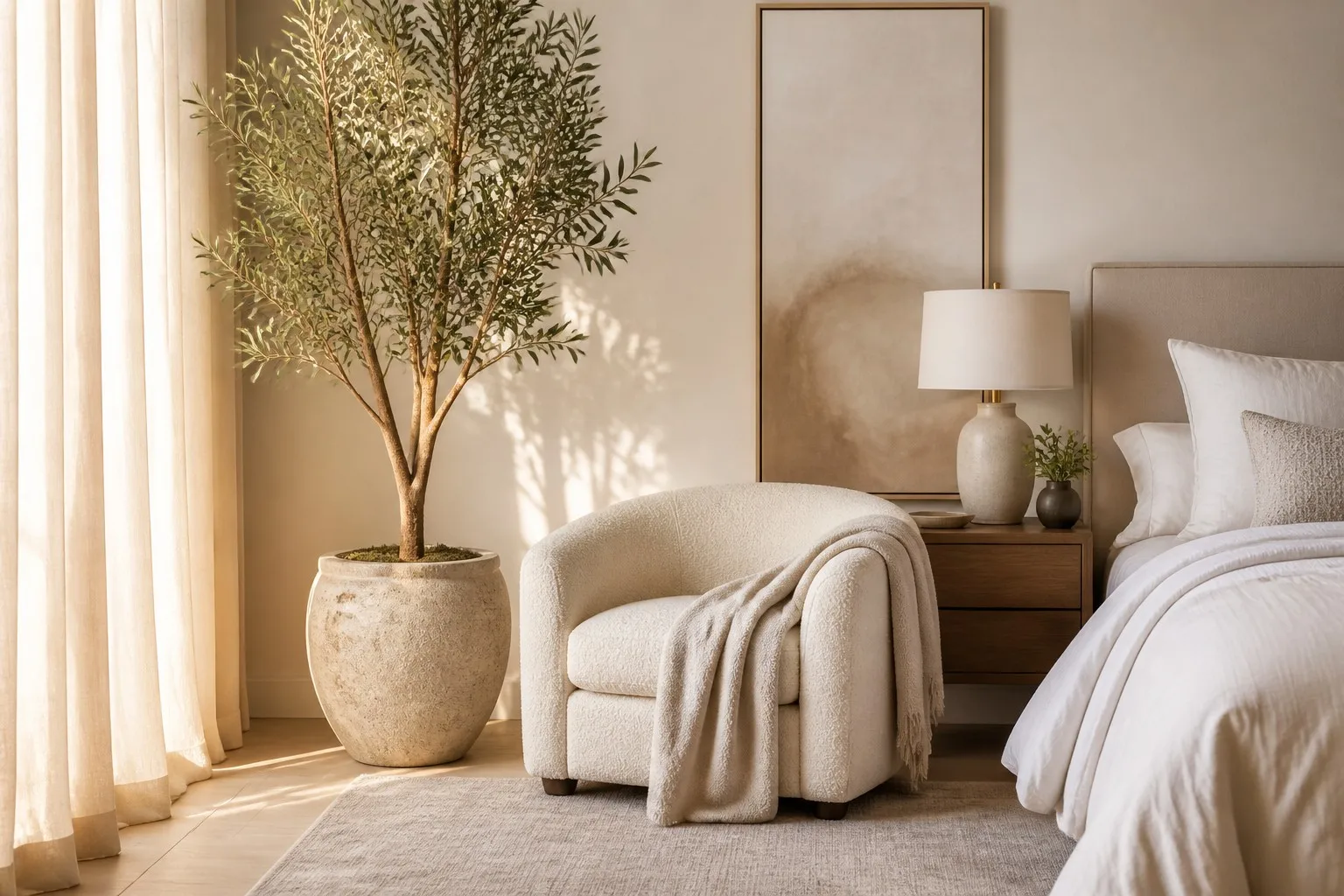
Styling illustration: a reading corner set up with a chair, a side table with a lamp, and a tall plant in a floor planter.
Key takeaways
- Choose the corner by the walking route. The path from the bed to the door, the closet and the bathroom stays clear.
- Put the chair where there is floor in front of it and a clear way past it, and keep the table and lamp inside your reach when you are seated.
- Set the plant in the corner behind or beside the chair, not in front of it, and leave its full spread clear of both the seat and the route.
- Light, wall art and one plant together build the vertical line in a corner. A group is the reliable way to make a low corner read taller, because the heights your listings actually publish are what you can buy.
Contents
- Start with the walking path
- Place the chair for standing up
- Put the table and the lamp inside your reach
- Where the plant goes in a reading corner
- Make a low corner read taller
- Layer textures and natural materials
- Light the corner for reading
- Listed heights and pot status
Start with the walking path
In most bedrooms the corner is empty because the route passes it, or because a door opens across it. Before you buy anything, walk the room and trace the lines you use every day: bed to door, bed to closet, bed to bathroom. A reading corner works when it sits beside that route rather than in it.
Then measure two things with a tape:
- The narrowest point of the route with the chair in place. Keep enough width that you can walk past without turning sideways.
- The gap between the corner and anything you walk around — the foot of the bed, a dresser, a wardrobe door. A wardrobe door that opens into the corner rules that corner out for a chair, whatever the empty corner looks like now.
Only once the route is clear do you have a usable footprint for the corner. Everything else on this page fits inside that footprint.
Place the chair for standing up
An accent chair pushed flat into a corner is hard to leave. Angle it instead: back against one wall, front opening toward the window or the centre of the room. That angle gives you the triangle of space behind the chair — which is where the plant goes — and floor in front of the seat, which is what you step into when you get up.
Two checks are enough with the chair in position:
- Floor in front of the seat. Measure from the front edge of the chair to whatever comes next — the table, the wall, the bed. That measurement is the space you have to stand into and to walk past.
- Floor beside the chair. The gap between the chair and the route you marked in the previous section stays clear, so someone can cross the room while you are sitting down.
How a chair feels to get out of depends on the chair itself, so this page does not read posture as a sign of missing space. What you can check with a tape is whether the floor in front of and beside the seat is there.
Put the table and the lamp inside your reach
The side table and the lamp are one decision. A table out of reach is a table you will not use, and a lamp you have to stand up to switch off is a lamp that stays off.
- With the chair in place, sit down and reach for the far corner of the table top. Move the table in until that corner is comfortable to reach.
- Measure the top of the chair arm and the top of the table. A table top level with, or slightly below, the arm is the easiest to use from the seat.
- Check the lamp base and shade against the table surface. The shade should sit so the bulb is not at eye level when you are sitting and reading.
- Trace the lamp cable from the socket on the lamp to the wall outlet. If it crosses the route you marked earlier, move the table or choose a different corner position for it.
The surface has to be furniture made for the job. Use a small side table, a side table on a manufacturer-rated stand, or a stable pedestal-style table beside the chair. Do not balance a lamp or a cup on a stack of books, and do not use books or a stack of boxes as the surface at all: they move, they are not rated for the load, and a lamp or a cup on top of them is a spill waiting to happen. If the corner is too tight for furniture, the honest answer is a smaller chair or a different corner, not an improvised stack.
Where the plant goes in a reading corner
The triangle behind an angled chair is the natural place for a plant: it is visible as you come into the room, and it is outside the floor you need to stand up. Keep four clearances in mind.
- Spread, not pot width. A listing height tells you how tall a piece is; it does not tell you how wide it spreads. Leave the full spread clear of the chair back and of the route, and measure the spread yourself once the plant is in place.
- Seat overhang. Nothing should lean over the seat or brush your shoulder when you sit down.
- Finished height. For a piece that arrives already in its pot, the listed height is the finished height and you do not add anything to it. For a bare-stem piece, the finished height is the listing's stem height P plus the height of the container's planting level L minus the length of stem that sits inside the container I — so P + L − I, measured on the actual container rather than assumed. A top-heavy floor piece is also stated by its own listing as needing a weighted or heavy container, so check the weight of the planter rather than its looks.
- The reader's light. If the plant stands between the chair and the window, check that it does not shade the chair or the page.
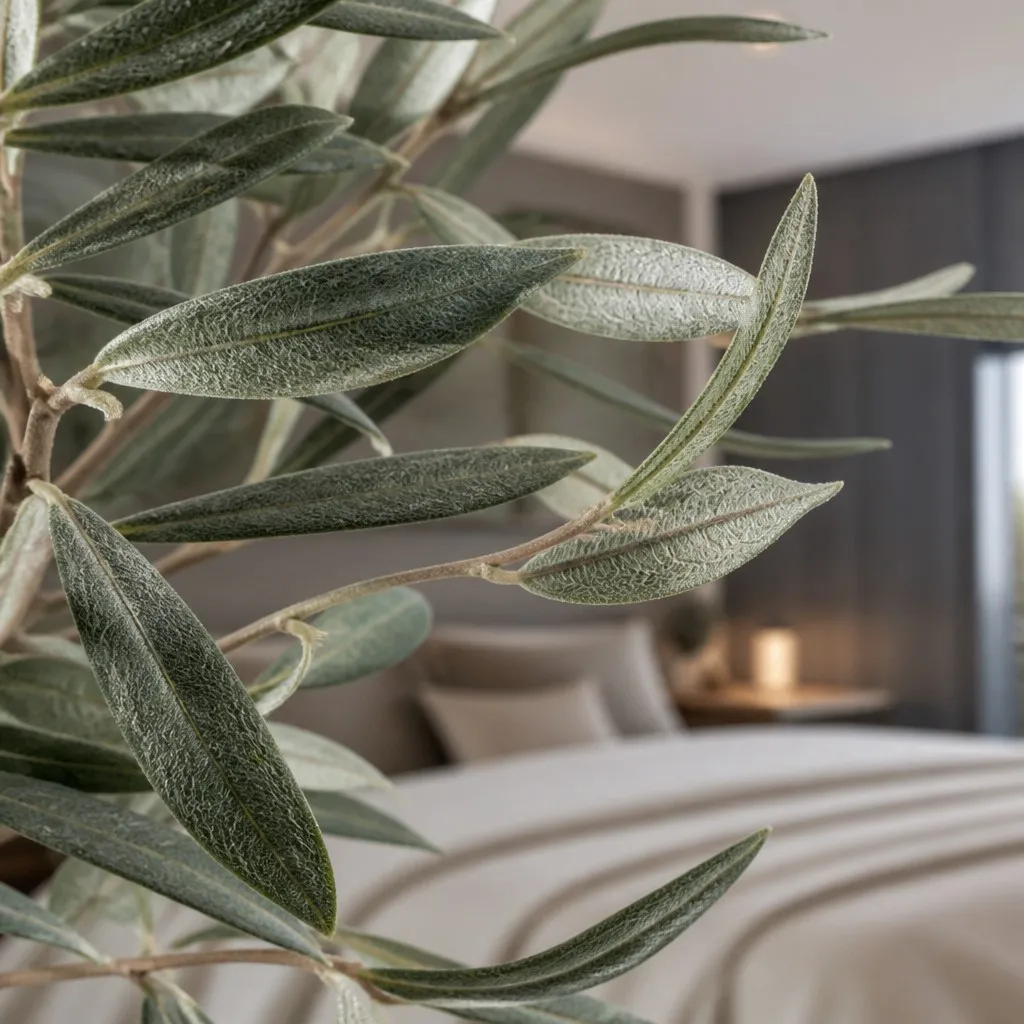
Styling illustration: a close view of the leaves you see from a chair beside a plant.
Make a low corner read taller
This page does not carry a "6-foot or 7-foot" target. There is no measured basis in this batch for a universal corner height, and the figures quoted for the pieces here are the listings' own, so the practical question is how to compose a corner that reads taller than the piece you can actually buy.
Four things do that work together:
- One plant with a tall line. The 24-leaf Monstera Deliciosa is the tallest piece verified for this batch: its title says 30 inches and its own product details say a 30.7-inch stem height, pot not included. Place it where its leaves interrupt the empty wall rather than directly behind your head.
- A lamp that draws the eye upward. A slim floor lamp or a wall-mounted light beside the plant adds a vertical line at eye level that a 30-inch plant cannot reach on its own. Keep it clear of the seat and out of your line of sight when you are reading.
- Wall art placed high. Hanging one framed piece so its centre sits well above the plant's top extends the vertical line without adding floor space.
- A group instead of one piece. A floor piece, a tabletop piece at a different height and a trailing piece on a shelf above read as a taller composition than any single 30-inch plant. Set each one on a real surface — a table, a shelf fixed to the wall, or a manufacturer-rated stand — not on books or boxes.
Two limits stay in force. No listing verified for this batch publishes a canopy spread, so the listed height is one dimension only. And the figures here cover the pieces named on this page, not the whole catalogue: check the current product page for whatever you are considering.
Layer textures and natural materials
Once the layout works, texture is what stops the corner reading as a chair parked in a gap. A small high-pile rug under the chair defines the zone and separates it from the rest of the floor. A woven basket beside the planter, a throw over the chair arm and a wooden or stone surface all add a second material next to the greenery.
Keep every layer inside the footprint you measured. A rug edge that lands in the middle of the route is a detail you will notice every day, and a basket in the walk line is the first thing you will move. For the room-wide version of this, see how to create a cozy bedroom retreat with plants and natural decor.
Light the corner for reading
Two light sources are the simple version: one task light you can switch off from the chair, and one low glow for the corner when you are not reading.
- Task light: aim the light at the page from beside the chair rather than over your shoulder from behind.
- Low glow: a small floor uplight near the base of the plant throws the leaves across the wall and gives the corner depth after dark. Keep the fitting and the cable clear of the plant's leaves and of any radiator, heater or vent, and keep the cable out of the route.
- Keep the shade out of your line of sight when you are seated, and keep any decorative piece near a light away from a heat source.
- If the corner has no outlet, settle that before you choose the furniture: a rechargeable lamp or a lamp placed near an existing socket changes where the table can go.
Listed heights and pot status
These are the pieces verified for this batch as reading-corner candidates, with the height, container and care wording exactly as each listing states it, read on 14 October 2026. Every figure is the listing's own description of itself, not a measurement we took, and this list covers these pieces only — it is not a statement about the rest of the catalogue.
- Lush Faux Monstera Deliciosa Plant (24 Leaves) — the listing's title says 30 inches and its own product details say a 30.7-inch stem height, pot not included. Its details also state that the 24-leaf canopy is top-heavy and that the base should go into a heavy vase or weighted urn, so treat the container as part of the purchase.
- Artificial Monstera Deliciosa Plant (18 Leaves) — listed at 29.5 inches in the title, with "Pot Not Included"; no separate height is given in that listing's details.
- 2.8ft Tall Large Artificial Money Tree (24 silk leaves) — listed at 2.8 ft, described as "No Decorative Planter", and stated in its details to have a weighted base that helps the tree stay upright.
- About 30 inches Faux Money Tree Artificial Plant (18 leaves) — listed at about 30 inches or 76 cm, described as "Decorative Pot Not Included", and the only piece here whose details state that the branches contain wire you can bend, fluff and shape.
- Real-Touch Faux Fiddle Leaf Fig Tree (19 in) — listed at 19 inches, title says "Pot Not Included", while its description says the tree arrives pre-potted in a weighted black starter pot filled with concrete. The two lines disagree, so confirm the container before you buy.
- Premium 19 in Artificial Fiddle Leaf Fig Tree — listed at 19 inches, the same title-versus-description disagreement: the title says "Pot Not Included" and the description says a weighted black starter pot with faux moss. Also unconfirmed, and the two fig listings are not evidence that both ship bare — treat each on its own page.
- Real Touch Pink Mini Artificial Orchid in Pot — described as approximately 15 inches or 38 cm and stated to include its pot, so this one is unambiguous. That 15 inches is this piece's own figure, not a general tabletop height.
- Real Touch Faux Pothos Plant in a Plastic Pot — stated as approximately 7 inches or 17.8 cm measured from the bottom of the pot to the longest vine, pot included. That 7 inches is not a pot diameter or a spread, and the listing states no trailing length and no pot diameter.
Container status, piece by piece: the orchid and the pothos state that a pot is included; the 18-leaf monstera, the 24-leaf monstera, the 18-leaf money tree and the 24-leaf money tree are listed as pot or planter not included; and both 19-inch fig listings contradict themselves between title and description. No container size or canopy spread is published for any of these, so check a planter's own listed dimensions before pairing it. For a room-by-room height comparison, see the artificial plant size guide for every room.
Care, as each listing states it: the potted Monstera (24 leaves) and the pothos allow a dry or slightly damp cloth, or a duster; the 18-leaf Monstera, the 18-leaf money tree, the 24-leaf money tree and both fig listings state no cleaning method in the details verified for this batch, so dust them dry with a soft cloth or a soft brush and follow the care note if the listing has one. Nothing here documents washing, rinsing, sprays or alcohol.
The pieces whose listings give a height without a container conflict are the 18-leaf monstera at 29.5 inches, the 18-leaf money tree at about 30 inches, the 24-leaf money tree at 2.8 ft with a weighted base, and the potted orchid at approximately 15 inches. The 24-leaf monstera is the tallest named here, so it suits the biggest corner, but it needs the heavy container its details describe. For a bare-stem piece, plan the finished height with P + L − I on the container you actually buy; nothing should be assumed about how a stem bundle stands until you have placed it.
One boundary worth keeping in mind: this page is about the reading corner itself. If the room still has an unplanned gap elsewhere — a bare floor corner, a dead wall above a dresser, an empty bedside surface or a strip at the foot of the bed — that decision belongs to the four-step method in the bedroom empty-space guide, which measures the gap before choosing a piece.
If there is a cat or a dog in the room, these are decorative objects rather than chewables or food, so keep the plant, any moss or pebbles and any small detachable part out of reach of animals and children that mouth things, and check the piece for loose parts after it has been moved. The pet-safe indoor plants guide covers the real-plant side of that question.
Final thoughts
Work in the order the room does: route first, chair second, table and lamp inside reach, plant last in the space that is left. A corner built that way stays usable at night when the lamp is on and in the morning when you walk past it with your hands full. Start with the tape measure rather than the plant, and the empty corner stops feeling like a gap in the room.